Winter
A Moveable FeastWinter in Paris is both a material hardship and a test of perception in Ernest Hemingway’s memoir: cold weather narrows the narrator’s choices, while attention to streets, river, and light gradually makes the season a world in which he can work. The first winter arrives as rain, smoke, and expense; after time in the mountains, winter returns clear and bright, and the city’s bare trees become beautiful. Between those versions, the season measures how poverty and work shape the experience of place, and how a difficult present can still leave room for spring.
The First Cold and the Cost of Shelter
The first cold rains make the city suddenly feel diminished. The narrator recalls that, once autumn was over, rain and wind stripped the leaves from the trees on Place de la Contrescarpe. The wet leaves lay against the ground, rain beat against the green autobus at the terminal, and the windows of Café des Amateurs clouded with heat and smoke. The café’s crowded interior offered no refuge for him: he avoided it for the smell of dirty bodies and drunkenness. Its regulars drank as much wine as they could afford, while the public notice against drunkenness had become as disregarded as the clientele was constant.
The season’s discomfort extends beyond the café into the city’s ordinary infrastructure. The memoir describes the narrow rue Mouffetard, old apartment buildings whose toilets emptied into cesspools, and horse-drawn tank wagons pumping them out at night. In summer, with windows open, the work’s odor carried into nearby rooms; at night, the brown-and-saffron wagons on Rue Cardinal Lemoine looked, in the moonlight, like Braque paintings. The contrast is characteristic of this winter writing: poverty and unpleasant labor are not erased by beauty, but the act of looking can hold both in the same cityscape.
Cold also makes heating a calculation rather than a comfort. In a top-floor room where he worked, the narrator considers the cost of kindling, paper-wrapped splints, and firewood, then hesitates over whether the chimney will draw. If smoke fills the room, the fuel and money will be wasted. Seeing no smoke from the neighboring chimneys, he walks on through the rain instead of risking a fire. His route passes the Lycée Henri Quatre, the church of St.-Étienne-du-Mont, and the windswept Place du Panthéon, before he finds shelter on the lee side of Boulevard St.-Michel and continues to a café he knows. Winter is registered in choices of route, fuel, and expenditure, not merely in the temperature outside.
Walking, Work, and the River
Walking gives the narrator a way to move through the season without treating the city as a succession of interiors. On another winter day, the park is locked, and he has to go around its lower end by rue de Vaugirard instead of walking through it. The detour makes him sad, as does the change from a bright start to a day that demands more work. He returns home to rue Cardinal Lemoine with the belief that work can cure almost anything. The season’s closed gates and difficult routes sharpen the importance of the room where he writes, but work remains an activity to resume, not an abstract consolation.
The river offers a different kind of company. From the top of rue Cardinal Lemoine, one route down is steep and ends at a bleak, windy stretch beside the Halle aux Vins, a bonded wine warehouse compared to a military depot or prison camp. Across a branch of the Seine lies Île Saint-Louis; farther along the quays, the view takes in Notre-Dame and Île de la Cité. The riverbank is not uniformly picturesque: its character changes with the path, the weather, and the workaday buildings beside it. Yet the narrator repeatedly walks there after working or when trying to think something through, finding it easier to think while moving and watching people absorbed in tasks they understand.
At the point of Île de la Cité below Pont Neuf, fishermen work the changing currents and backwaters. Their positions shift with the river’s height; they use long jointed cane poles, fine leaders, light tackle, and quill floats. The narrator does not fish, lacking tackle and preferring to save money for fishing in Spain, but he follows the practice closely. On a bright day he may buy a liter of wine, bread, and sausage, sit in the sun with a book, and watch. Barges with lives aboard, tugs lowering their smokestacks to pass under bridges, and fishermen taking fish home keep the river from becoming a lonely place. Winter belongs to this larger cycle: its cold and bare branches are real, but the river and the people beside it continue their work.
From Winter’s Hardness to Its Beauty
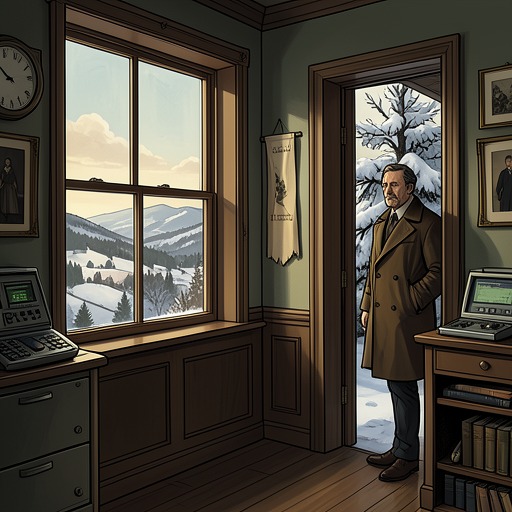
After the return from the mountains, the city is again cold, but the narrator’s relation to winter has changed. There is good wood for sale across the street, braziers warm the terraces of cafés, and the apartment is cheerful. The household burns molded egg-shaped lumps of coal dust on a wood fire. In the Luxembourg gardens, bare trees stand against the sky and the gravel paths have been washed clean. Once reconciled to their leaflessness, the narrator sees the trees as sculpture; wind moves across the ponds, and the fountains catch the bright light. The mountain stay has made Paris’s distances seem short, and the climb to the top-floor workroom has become pleasurable rather than burdensome.
That room is warm, and its fireplace draws well. Hemingway brings mandarins and roasted chestnuts upstairs, eating them while he works and throwing the citrus skins and seeds into the fire. Hunger accompanies walking, cold, and writing; chestnuts and fruit answer it in small, concrete ways. A bottle of kirsch brought back from the mountains marks the end of a story or a day’s work. When the work is done, the notebook or paper goes into a drawer, and any remaining mandarins go into a pocket so they will not freeze in the room overnight. The season’s cold still governs the household’s routines, but it no longer makes the room unusable: fire, food, and disciplined work have made it inhabitable.
Seasonal Loss and Return
The memoir makes winter part of a recurring seasonal measure. In the city, spring can be seen approaching through the trees, day by day, until a night of warm wind brings it suddenly into view. Cold rain may then beat it back, making the season seem lost. Hemingway distinguishes this from the sadness expected in autumn, when falling leaves and bare branches make each year feel partly diminished. Winter’s particular threat is the interruption of renewal: when rain seems to kill the spring, the loss feels unnatural, like the death of a young person without reason. Yet spring eventually arrives, and the fear that it might not is part of its force.
Winter also frames a larger movement between Paris and the mountains. Schruns, in Vorarlberg, offers a sunny market town and an inexpensive, comfortable base at Hotel Taube, where Hemingway, Hadley Richardson, and their child can live for about two dollars a day. After returning to Paris from the mountains, the narrator again experiences the city through cold and work, but with a changed sense of distance and landscape. The seasonal return does not restore the earlier moment unchanged: the narrator observes that Paris changes as its inhabitants do, and that the first part of their life there has ended. Winter therefore holds together hardship and accommodation, enclosure and movement, the fear of a season’s failure and confidence in its return. It is not only weather in the memoir, but a recurring measure of what poverty costs, what work can sustain, and what the city gives back to those who remain attentive to it.